What the ranking is built on
1. The network, which is the only thing that changes with a group
Rank intercoms on features and you rank them wrongly, because the feature lists converge and the networks do not. Two of the six picks here publish a mesh capability and four publish Bluetooth intercom only, and that single split predicts how each one behaves on a Sunday ride better than any other spec.
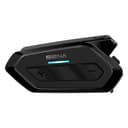
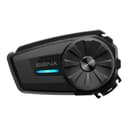
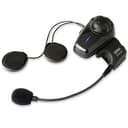
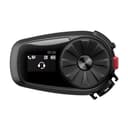
The Spider RT1 publishes Mesh Intercom 3.0 outright. The Spider ST1 publishes Open Mesh plus Bluetooth — note the wording, because it matters: Open Mesh is the public-channel mode, so the ST1 joins a mesh ride without the private Group Mesh depth of the 50- and 60-series units. Both are a different proposition from the SMH10, which publishes a four-rider Bluetooth intercom at up to 900 m, and from the 5S, which publishes a two-rider Bluetooth intercom at up to 700 m. The two Cardos here publish two-rider Bluetooth, at up to 400 m for the Spirit.
One consequence people discover the hard way: mesh does not cross brands. Cardo’s DMC and Sena’s Mesh are separate protocols, and two riders on different brands fall back to Bluetooth to talk to each other, losing the mesh behavior both paid for. If your regular group already runs one brand, that is the strongest argument on this page for which of these to buy, and it outranks every number below.
2. Published rider count and range, read as a maximum rather than a promise
Every range figure in this category — 900 m, 700 m, 400 m — is a line-of-sight maximum in open terrain with nothing between the units. A bend, a truck or a hill takes it apart, and no maker pretends otherwise in the small print. We publish the figures because they are the maker’s own and they are comparable to each other; we will not tell you what they mean on your road. Treat the rider count the same way: a four-rider Bluetooth intercom is four riders in a chain, which is not the same thing as four riders in a mesh.
3. Speaker size, and the thing nobody publishes
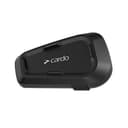
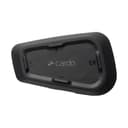
Four of the six picks publish 40 mm drivers: the Spider RT1, the 5S, and the Cardo Spirit HD with what Cardo calls 40 mm HD speakers. The Cardo Spirit publishes 32 mm, and that is the clearest hardware difference between the two Cardos here. Note what the Spirit HD does not say: its 40 mm drivers are not described as Sound by JBL, which is the tuning Cardo reserves for its Freecom and Packtalk families. A driver size is a dimension, not a sound quality rating, and there is no sound quality rating in this category at all.
4. Waterproofing, where the wording is the specification
This is the specification most worth reading literally. Sena publishes IPX7 for its top-end units and Cardo publishes IP67 for the Packtalk family — but for both Cardo units on this page, Cardo says only “waterproof” and publishes no IP rating at all. That is on both cards, because the difference between a tested IP figure and the word “waterproof” is exactly the kind of gap a buying guide exists to point at. It does not mean the Spirits leak. It means nobody has told you how they were tested.
Which one, in one paragraph each
You ride with a group of three or more. Buy the Spider RT1 and accept the three-button control. Mesh is the whole reason, and under this ceiling it is the only unit that publishes Mesh 3.0. The group-riding page covers what changes above this price, and our mesh intercom ranking is the page to read if you are willing to cross the line.
You and one other rider, always the same two. The Sena 5S is built for exactly that — a two-rider Bluetooth intercom with 40 mm speakers and the Jog Dial, which is the control that works best in winter gloves. Our rider-and-passenger page goes deeper on the pillion case, where a single unit split across two helmets is sometimes the right answer.
A fixed group of four who all buy the same thing. The SMH10 publishes four-rider Bluetooth at up to 900 m, which is the longest Bluetooth figure on this page, and the Jog Dial again. It is also the oldest platform here. Buy it because the chain genuinely suits a small fixed group, not because it is nearly mesh — it is not.
Mostly music, navigation and calls. The Cardo Spirit HD at 40 mm with FM radio, or the Spirit at 32 mm if the budget is the point. Neither is a group unit and neither pretends to be: both publish two-rider Bluetooth. If talking to other riders is not the job, you are not buying an intercom, you are buying a helmet audio set, and the cheaper of the two does that job.
What $200 does not buy in comms
Four things, and they are the reasons to cross the line rather than stay under it. It does not buy private Group Mesh depth — the large-group modes with named channels live on Sena’s 50- and 60-series and Cardo’s Packtalk family. It does not buy audio-brand tuning: Harman Kardon and Bose on Sena’s flagships, Sound by JBL on Cardo’s. It does not buy a published IP rating from Cardo, which starts at the Freecom family. And it does not buy charge-while-riding or a clickable Air Mount, both of which Cardo publishes for the Packtalk Edge and above.
It is also worth knowing what is not on the other side of the line. Battery life does not scale with price at Cardo — Cardo publishes 13 hours across both the Packtalk and Freecom families — and the Spider RT1 under this ceiling publishes up to 20 hours of talk time, which is more than several units costing twice as much. Cardo versus Sena lays that pattern out across both ranges, and alternatives to Sena and alternatives to the Packtalk are the pages to read if you have settled on a brand and want the other side of the argument.
If your ceiling is lower than this page’s, our budget intercom ranking goes further down, including the sub-$50 options and what they genuinely cannot do. If it is higher, the best motorcycle intercoms spans the whole market. And before you buy anything, how to choose a motorcycle intercom covers the one question that decides more purchases than price: whether a helmet with comms built in is the better route for you in the first place.