Forma Adventure vs Alpinestars SMX-1 R V2
A tall waterproof adventure boot against a short certified sport-touring boot. One of these two covers your shin; the other is one of only four boots in our registry whose maker publishes EN 13634 by name. You cannot have both.
Buy the Forma Adventure if you ride dirt roads, stand on the pegs and need your shins covered. Buy the Alpinestars SMX-1 R V2 if your adventure bike spends most of its life on tarmac and you want a boot whose maker actually publishes a footwear standard. That is the whole decision, and it is unusually clean, because these two boots disagree on both axes at once rather than trading a little of each.
Here is the finding that makes this page worth writing. Of the 17 boots in our registry, 11 publish no footwear standard at all. Six publish something, and only four of those are a maker naming EN 13634 on its own product page. The SMX-1 R V2 is one of the four. The Forma Adventure is one of the eleven — and it is also, by a wide margin, the better-covered boot of the two. If you expected coverage and certification to travel together in this category, they do not, and that is the honest shape of the adventure-boot market rather than a knock on either product.
One thing before the table. We have worn neither boot. We own no stock, run no lab and crash-test nothing. Alpinestars’ column comes from Alpinestars’ own product page, read on a dated visit and cited at the bottom. Forma’s column comes from the live retail listing recorded in our registry on a dated visit — we could not reach a Forma-published specification for this boot, and where retailer pages quote a certification that the maker does not, we do not repeat it. Our methodology page spells out what that means.
How this is funded: we earn a commission if you buy through our links, at no extra cost to you. It never changes which gear we recommend, and we’ll tell you plainly when to skip a pick. Full disclosure.
Tall, waterproof, uncertified on paper
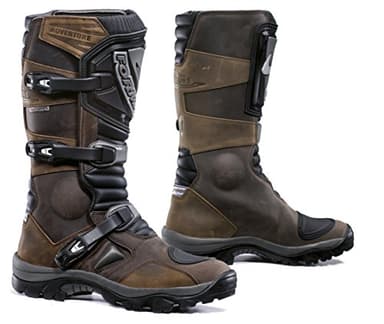
Forma Adventure Boots
The value adventure-touring boot a lot of ADV riders settle on: tall protection, a walkable sole and a waterproof membrane, without the four-figure price of a hardcore off-road boot.
Price as of October 22, 2026. #ad How we’re funded
Short, microfiber, EN 13634:2017 published
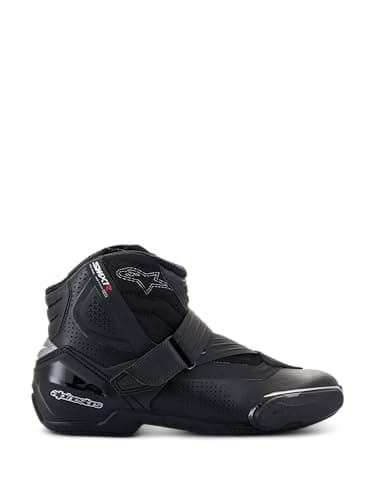
Alpinestars SMX-1 R V2
The cheapest boot in this registry that carries Alpinestars' own CE EN 13634:2017 statement, in a short shaft a new rider can actually walk in. TPU heel counter, lateral ankle and shift pad, a transverse protection frame in the sole, and a Velcro strap plus reverse zip rather than a ratchet to fight with at the kerb.
Price as of October 22, 2026. #ad How we’re funded
| Spec | Forma Adventure Boots | Alpinestars SMX-1 R V2 |
|---|---|---|
| Footwear standard published by the maker | None we could verify from Forma | CE EN 13634:2017, stated by Alpinestars on its own product page |
| EN 13634 performance levels | Not published | Not published — Alpinestars gives the standard, not the four levels |
| Shaft height | Tall — full shin coverage | Short — roughly ankle height, above the bone and no higher |
| Upper material | Oiled full-grain leather, waterproof | Lightweight abrasion-resistant microfiber with TPU protectors |
| Waterproofing | Waterproof membrane in a leather upper | None published — this is not a wet-weather boot |
| Hard protection named | Ankle, shin and malleolus protection | External high-modulus TPU heel counter, lateral ankle and shift pad |
| Sole | Walkable lugged sole | Rubber compound with an integrated Alpinestars TPF transversal protection frame |
| Closure | Buckles and strap over a tall shaft | Front Velcro strap over the instep plus a reverse zip |
| Sizes published | Standard EU adventure-boot range; the listing runs slightly large | UK 4.5-13.5 / EU 38-50 |
| Walkable off the bike | Yes, for an ADV boot — that is the model's whole pitch | Yes, easily — it is a short boot with a flex zone and a zip |
| Price tier | Mid | Mid |
| Who it is for | Adventure and dual-sport riders who leave pavement and walk in their boots | Riders who want a certified boot they will actually put on for a commute |
The criteria, before the verdict
A boot does four jobs, and adventure riders weigh them differently from everyone else:
- Keep the ankle from rotating. The injury that ends rides is a twist, not a scrape. This is what a heel counter, a malleolus cup and a stiff sole plate are for.
- Cover the shin.Only relevant off pavement and when a bike lands on you — which is exactly the adventure case, and exactly why ADV boots are tall.
- Survive a slide.Abrasion and cut resistance of the upper, which is what EN 13634 tests and what nobody can assess by looking at a photo.
- Be wearable.A boot you leave at home protects nothing. This is not a soft criterion — it is the one that decides whether the other three ever apply.
The Forma wins 1 and 2 outright. The Alpinestars is the only one of the two with a published answer on 3. They are close on 4, in different ways: the Forma is a tall boot you can genuinely hike in, the Alpinestars is a short boot you can wear to an office.
What EN 13634 actually buys you — and what it does not
EN 13634 is the European standard for motorcycle footwear. Dainese, which certifies to it, publishes the clearest manufacturer explainer we have found: “Motorcycle footwear is certified according to European standard EN13634, which provides two levels of certification”, with the mark on the lower part of the tongue carrying four numbers that read, in order, upper height, impact abrasion level, impact cut level and transverse rigidity level. Each is scored on its own, so one boot can hold different levels across the four.
That last point is the reason a bare “EN 13634” claim tells you less than it sounds like. Alpinestars publishes the standard for the SMX-1 R V2 — verbatim, “The following standards apply: CE EN13634:2017” — and does not publish the four levels. So you know the boot was tested and passed. You do not know whether it passed abrasion at level 1 or level 2, and Dainese’s own figures put real distance between those: the abrasion sample has to last at least 5 seconds for level 1 and 12 seconds for level 2, and the cut test allows no more than 25 mm of blade penetration for level 1 against 15 mm for level 2.
We put the whole standard, the four digits and how to read the label inside your own boots in our EN 13634 guide. The short version for this comparison: the Alpinestars claim is meaningful and incomplete, and the Forma has no claim we can verify at all. Those are different problems and the second one is bigger.
Why the tall boot is still the right answer off pavement
It would be neat if the certified boot were also the better boot. It is not, for the riding this page is about.
A short boot cannot protect a shin, and no certification changes that. EN 13634’s first digit is literally upper height, which is the standard acknowledging that coverage is a measured property of the boot rather than a bonus. When an adventure bike goes down on a gravel road it tends to come down with you, and the contact area is the shin and the inside of the calf. The Forma’s tall shaft, shin plate and malleolus protection are the entire reason the model exists.
Add the waterproofing, which is not a comfort feature on a multi-day trip. An oiled full-grain leather upper over a membrane is the conventional ADV construction because it survives being soaked, dried and soaked again — at the cost of needing care to stay waterproof, which is a real ongoing chore and one of the honest downsides of this boot.
Why the short boot wins more days than riders admit
The counter-argument is unglamorous and usually correct for anyone whose adventure bike is mostly a road bike.
A tall ADV boot is a commitment. You put it on in the hallway, you cannot drive a car in it comfortably, and you will not pull it on for a fifteen-minute errand. The SMX-1 R V2 goes on with a zip and a Velcro strap, walks like a normal shoe, and is certified to the footwear standard — which puts it ahead of 11 of the 17 boots we track on the one axis you cannot inspect yourself. For a rider doing a commute plus occasional fire roads, the boot that gets worn every day beats the boot that gets worn on trips.
It is also the cheaper of the two, and it is the boot we put first on our ranking for riders buying their first certified boot, for exactly these reasons.
The honest cons, both ways
| Boot | What is genuinely wrong with it |
|---|---|
| Forma Adventure | No footwear standard we can verify from Forma, which on a protective product is the single biggest gap on this page. It is not a competition off-road boot either, so hard enduro riders are in the wrong category. The leather needs treating to stay waterproof. And the listing runs slightly large, which matters more on a tall boot than a short one |
| Alpinestars SMX-1 R V2 | A short boot protects less of the leg, by design — that is the trade and not a defect. Alpinestars publishes the standard but not the four performance levels, so you cannot tell level 1 from level 2. No waterproofing is published, so wet multi-day riding is out. And it is microfiber rather than leather: it will not patina and it will not last the way leather does |
If you want tall coverage for less
There is a third shape to this decision worth naming, because plenty of riders want shin coverage and do not want to spend ADV-boot money. It is a real option with a real compromise: tall and cheap, with no published standard and no pretence of being walkable.
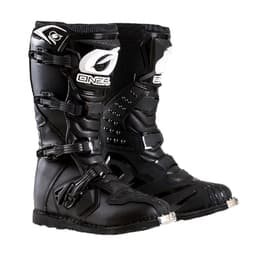
Tall coverage, budget price, nothing published
O'Neal Rider Boots
A tall MX-style boot at a genuinely low price: shin plate, buckles and a reinforced structure for riders who want maximum coverage for minimum money. Off-road-oriented, but the coverage is real.
See the budget boot rankingBottom line
Dirt, weather and standing on the pegs: the Forma Adventure, and accept that its protection is unverified on paper. A tall waterproof boot with shin and malleolus protection is the right tool for adventure riding and nothing in a short boot substitutes for it.
Tarmac, commuting and a boot you will actually wear: the Alpinestars SMX-1 R V2, and accept that it stops at the ankle. It carries Alpinestars’ own EN 13634:2017 statement, it is cheaper, and it is the easier boot to live with every day.
If you are still deciding on the category rather than the model, our adventure-touring boot ranking puts both of these in a wider field, and our boot buying guide covers height, closure and certification in the order they matter.
Frequently asked questions
Is the Forma Adventure CE certified?
Forma does not publish a footwear standard for this boot anywhere we could verify, so our registry records none. Several retailer listings do quote EN 13634:2017 for Forma's Adventure line, and we deliberately do not repeat that: a retailer's description is not the manufacturer's published specification, and certification is per model and per construction. If the certification is the deciding factor for you, the practical move is to read the CE label inside the boot when it arrives — EN 13634 marks go on the lower part of the tongue — and return it if it is not there.
Which boot is safer, the Forma Adventure or the SMX-1 R V2?
Neither answer is available, and anyone who gives you one is guessing. They protect different things: the Forma covers the shin and ankle in a tall waterproof leather upper, and the Alpinestars is the only one of the two whose maker publishes that the upper passed EN 13634:2017 for abrasion, cut and transverse rigidity. A tall uncertified boot and a short certified boot are not on the same scale. Our read is that for off-pavement riding coverage dominates, and for road riding the published standard does.
Can I use the SMX-1 R V2 for adventure riding?
On graded dirt roads and gravel, yes, with the understanding that your shins are unprotected and your feet will get wet. For genuine off-pavement riding — standing on the pegs, rocks, ruts, the possibility of the bike landing on your leg — a short boot is the wrong tool and we would not recommend it. The honest framing is that the SMX-1 R V2 is a sport-touring boot that an adventure rider can use on the road half of the trip, not an adventure boot.
Are adventure boots waterproof?
The good ones are, and it is one of the main reasons they cost what they do. The Forma Adventure pairs an oiled full-grain leather upper with a waterproof membrane, which is the standard ADV construction. Alpinestars publishes no waterproofing for the SMX-1 R V2 at all, so treat it as a dry-weather boot. Note that leather waterproofing is maintained rather than permanent — the membrane keeps working, but the leather needs treating or it wets out and the boot feels soaked even when water has not reached your foot.
How tall should an adventure motorcycle boot be?
Tall enough to cover the shin, which in practice means the shaft reaches most of the way to the knee. EN 13634's first digit is upper height, which tells you the standard treats coverage as a measured protective property rather than a style choice. The trade is walkability and heat: a tall boot is hotter, stiffer and harder to hike in, which is why the Forma Adventure's lugged walkable sole is the feature ADV riders actually talk about. If you cannot live with a tall boot, buy a short certified one and ride accordingly rather than buying a tall boot you leave in the garage.
Do many motorcycle boots publish a certification?
Fewer than you would expect. Across the 17 boots in our registry, 11 publish no footwear standard of any kind, 6 publish something, and only 4 of those are a manufacturer naming EN 13634 on its own product page — all four of them Alpinestars. One more names the four-digit EN 13634 code in its listing title, and one says only 'CE-certified' without naming a standard. Not a single boot we track has all four EN 13634 performance levels published by the maker. That is the state of the category, and it is why we rank on what is published rather than on brand reputation.
Does a boot certification expire?
The certification does not, but the boot does. EN 13634 applies to the model as tested, and it does not lapse on a date. What degrades is the boot: leather dries out and loses water resistance, TPU hardware cracks with UV exposure, soles separate and stitching fails. A boot whose sole is parting company with the upper is not performing to any standard regardless of what the label says. Our guide on how long gear lasts covers what to look for.
Sources
- Alpinestars — SMX-1 R V2 Boots (maker's product page) — Alpinestars' own certification statement, verbatim: "According to European statutory law the CE mark is a conformity requirement for the marketing of this product." and "The following standards apply: CE EN13634:2017." Published construction: "lightweight and abrasion-resistant microfiber upper" reinforced with strategically placed TPU protectors; "External, high modulus TPU heel counter, lateral ankle and shift pad"; microfiber instep and Achilles accordion flex zones; a rubber compound sole with an "integrated Alpinestars TPF (Transversal protection Frame)" against transverse loads; thermowelded flex grooves; a front Velcro closure over the instep with aramidic-fiber strap wires and a TPR puller; and a reverse zip entry. Sizes UK 4.5-13.5 / EU 38-50. Alpinestars publishes the STANDARD and not the four EN 13634 performance levels, and publishes no ventilation or perforation spec even though the US retail listing calls the boot "Vented" (accessed October 15, 2026)
- Dainese — How does certification for motorcycle shoes and boots work? — A manufacturer's own explainer of the standard it certifies to. Dainese publishes: "Motorcycle footwear is certified according to European standard EN13634, which provides two levels of certification"; the symbol sits "on the lower part of the tongue" and "indicates the reference standard and the final level"; the four numbers read, in order, upper HEIGHT, impact ABRASION level, impact CUT level and TRANSVERSE RIGIDITY level, and "Each test is evaluated individually" so one boot can hold different levels across the four. The numeric thresholds Dainese publishes: impact abrasion "To achieve level 1 certification, the sample has to last at least 5 seconds; for level 2, 12 seconds"; impact cut "No more than 25 mm for level 1 certification, no more than 15 for level 2". It describes the abrasion rig as 60-grit sandpaper simulating asphalt, the cut test as a blade dropped at 2.8 m/s, and transverse rigidity as sole deformation measured under a press. Other manufacturer documents quote lower abrasion seconds because EN 13634 tests two zones of the boot separately — which is why this page attributes the figures to Dainese rather than asserting them as the standard's own numbers (accessed October 15, 2026)
- MotoCAP — Independent Motorcycle Clothing & Helmet Assessment — Independent Australian lab rating protective clothing and helmets for protection and comfort (accessed July 21, 2026)
Keep reading
Best adventure-touring boots
Both of these boots in a wider field, ranked on height, waterproofing and what each maker publishes.
See the rankingEN 13634 explained
The four digits on a boot's CE label, what each one measures, and why a bare 'EN 13634' claim is incomplete.
Read the explainerBest boots for a first certified pair
Where the SMX-1 R V2 ranks for riders buying their first boot that publishes a standard.
See the beginner picksHow to choose motorcycle boots
Height, closure, sole and certification in the order they matter, before you pick a model.
Read the buying guideBest waterproof motorcycle boots
If the membrane is the deciding feature, this is the ranking built around it.
See the waterproof picksAre motorcycle boots necessary?
The case for boots over work boots or trainers, and the injury that makes the argument.
Read the answerHow long does gear last?
When leather, membranes and TPU hardware stop doing their job, boots included.
Read the guide